
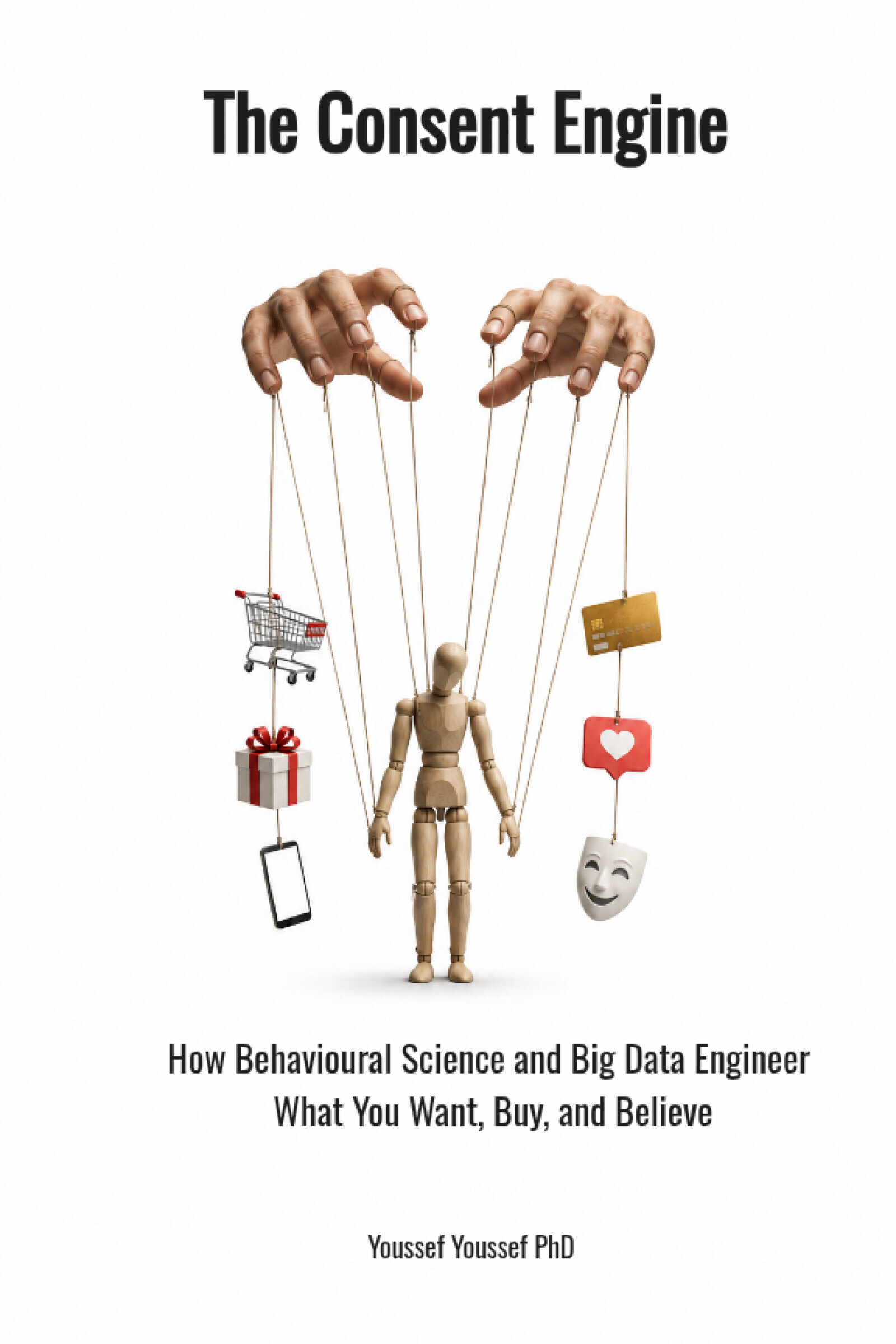
Description
In 1928, Edward Bernays put feminist actresses on Fifth Avenue with cigarettes in their hands and sold tobacco to half of American womanhood. He called what he did the engineering of consent. He had no idea what was coming.
Bernays ? Sigmund Freud’s nephew, the inventor of modern public relations ? believed that the systematic management of public opinion was the precondition of democracy in a mass society. He worked with the bluntest of instruments: opinion polls, focus groups, the typewriter, the press release.
A century later, his successors are working with rather more.
The Consent Engine traces the line from those torches of freedom on Fifth Avenue, through the behavioural revolutions of Kahneman, Cialdini, Thaler and Damasio, to the contemporary apparatus of programmatic advertising, psychographic targeting and AI-driven persuasion that now operates, continuously and invisibly, on every person who carries a phone.
Drawing on cognitive neuroscience, behavioural economics and twenty-five years of practitioner experience, the book explains how every click, scroll, search and pause is now harvested, profiled and sold; how Cambridge Analytica was not an aberration but a preview; how large language models are quietly becoming the deepest consumer-intelligence platform ever built; and why the most consequential question of the next decade is not what the consent engine can do, but who decides what it should be allowed to do.
This is a book for the practitioner who wants to operate ethically inside a system that rewards the opposite. It is also a book for the citizen who suspects, correctly, that something has shifted in the relationship between what they think they want and what someone else has arranged for them to want.
Bernays warned, at the end of his life, that competence without conscience was the most dangerous form of professional failure. The Consent Engine is an extended argument that he was right ? and a working guide to what to do about it.

Reviews
There are no reviews yet.