
Description
Is the question of machine consciousness an engineering problem, a philosophical puzzle, or a religious mystery? It is all three — and that is precisely why no single discipline has been able to settle it.
The most urgent question of our age — whether artificial minds could become aware — is being carried on as three conversations in the same room that never quite intersect. Engineers ask whether systems can pass behavioral thresholds. Philosophers ask whether functional descriptions can capture phenomenal experience. Religious and contemplative thinkers, when invited at all, tend to be invoked rhetorically rather than engaged seriously. The result is a confused public debate, and a private confusion in anyone who tries to think the whole question through honestly.
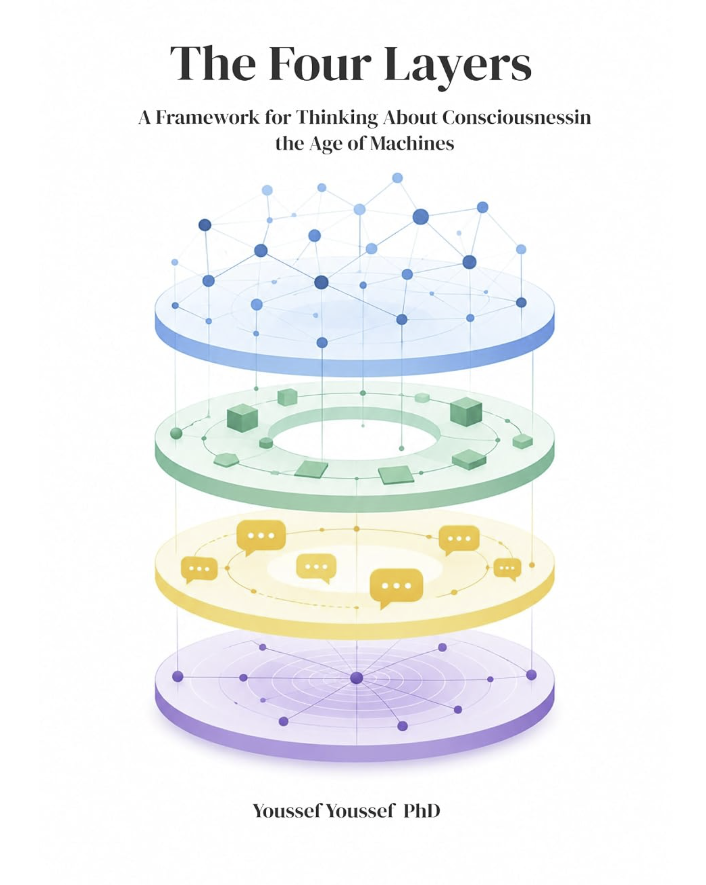
In The Four Layers, Youssef Ahmad Youssef offers a framework that lets each tradition speak where its expertise actually lies. Four layers — Architecture, Presence, Interpretation, Ground — organize the conversation without forcing it into premature consensus. Consciousness science contributes most cleanly at Layer 1. The contemplative inheritance is the long-baseline first-person record at Layer 2. The world’s religions and cultures construct the self differently at Layer 3. And the metaphysical commitments that make any of it count live at Layer 4.
With the framework in hand, the book takes on the major contemporary disagreements — Anil Seth’s vitalism analogy, Daniel Dennett and Keith Frankish on illusionism, Thomas Metzinger’s elimination of the self, Philip Goff and Bernardo Kastrup’s metaphysical alternatives, and Geoffrey Hinton’s strong claims about machine experience — not to settle them, but to make them disagree intelligibly. It then turns the framework on the questions that pressed in the first place: machines that almost dream, death and the end of awareness, contemplative practice as inner laboratory, and the ethics of living among other minds — human, animal, and artificial.
The book is also transparent about how it was written. Developed through extended dialogue with large language models, with the author retaining full intellectual responsibility, The Four Layers is an early example of serious nonfiction that names its method instead of concealing it.
For readers of Anil Seth, David Chalmers, Annaka Harris, Thomas Metzinger, and Iain McGilchrist — and for anyone who has felt that the loudest answers to the consciousness question are also, somehow, the most evasive.



Reviews
There are no reviews yet.