
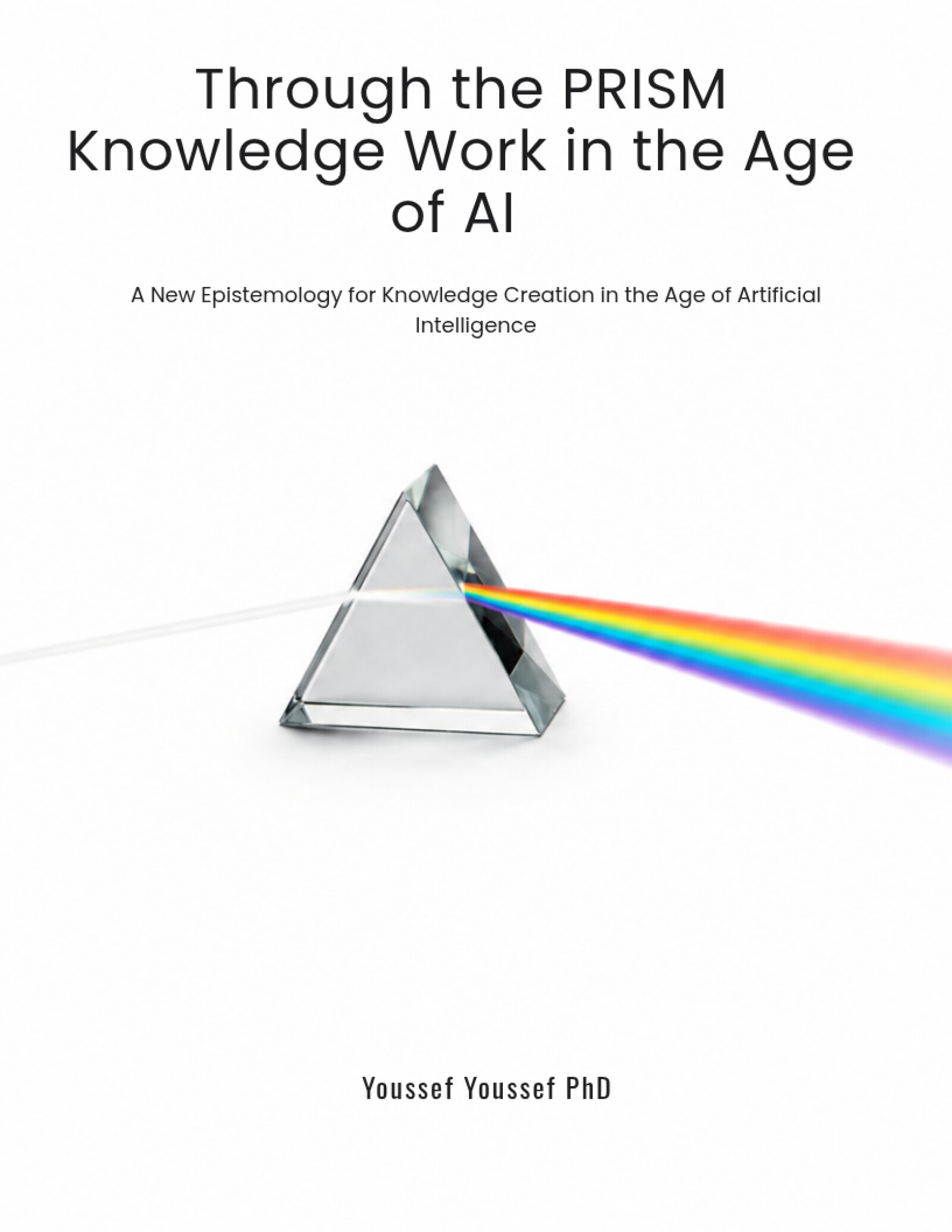
Description
Six to eighteen months after deploying AI tools, knowledge-intensive firms see a pattern that leadership can perceive but cannot name: throughput rises, deliverables proliferate — and the judgment of junior practitioners quietly stops developing.
This is the central management problem of the AI era, and the frameworks built for an earlier age cannot describe it. Nonaka and Takeuchi’s SECI model — the dominant theory of organizational knowledge for three decades — presupposes that every participant in knowledge work is a knowing subject with shared phenomenal context. Large language models break each of those presuppositions.
Through the PRISM offers the successor framework.
Drawing on sustained fieldwork in consulting firms, hospitals, law firms, design studios, research institutes, and public-sector agencies, Dr. Youssef A. Youssef develops PRISM — Prompting, Refraction, Interpretation, Synthesis, Mobilization — a five-phase cycle calibrated to professional work as it actually happens under AI mediation. The framework rests on a substantive theoretical move: AI output is not a new kind of explicit knowledge. It is a third epistemic category — symbolic refraction — distinct from both tacit and explicit knowing. The practitioner’s work in the age of AI is the work of navigating refractions with judgment intact.
Inside the book:
- The five PRISM phases and what each contributes to professional work
- Four structural dimensions firms can be diagnosed against — temporal architecture,
interpretive infrastructure, mobilization protection, and transmission ecology - Five firm typologies — Productivity-Optimized, Deliberately-Protected, Bifurcated, Struggling, and Transitioning — each with its own intervention pattern
- A vocabulary for phronesis (practical wisdom) and how to protect its formation across cohorts under AI
- A diagnostic logic for assessing your own firm against the framework
- Practical chapters on building interpretation cultures and protecting the moments of consequence in professional work
The book is written for three readers. The consultant who advises organizations on knowledge work and finds the existing frameworks straining. The senior executive who senses that her firm’s relationship to AI is more than a productivity question and cannot quite name what it is. And the scholar who wants a serious engagement with knowledge theory in the age of large language models.
Through the PRISM is a successor argument, not a replacement. It is a tribute to what Nonaka and Takeuchi gave the field — and an attempt to draw the new map their framework can no longer fully chart. For leaders making AI adoption decisions whose long-term consequences are not yet visible, it offers the language and the diagnostic frame those decisions deserve.
Reviews
There are no reviews yet.